Career Overview
Brady Corbet emerged from a prolific acting career to establish himself as one of the most uncompromising voices in contemporary cinema. Transitioning from working under the direction of established auteurs, Corbet absorbed a rigorous cinematic vocabulary that he quickly adapted to his own monumental ambitions. His evolution as a filmmaker is defined by an absolute refusal to adhere to conventional commercial expectations. Instead, he pursues sprawling historical canvases that challenge both the medium and the audience.
His developmental trajectory reveals a filmmaker obsessed with the intersection of historical trauma and individual psychology. By moving behind the camera, Corbet cultivated a demanding aesthetic that prioritizes structural audacity over easy consumption. This transition positioned him as a polarizing but undeniable force in modern independent cinema, a director who swings for the fences with every project. His background informs his ability to extract profoundly commanding performances from his cast, grounding his epic visual tendencies in raw human emotion.
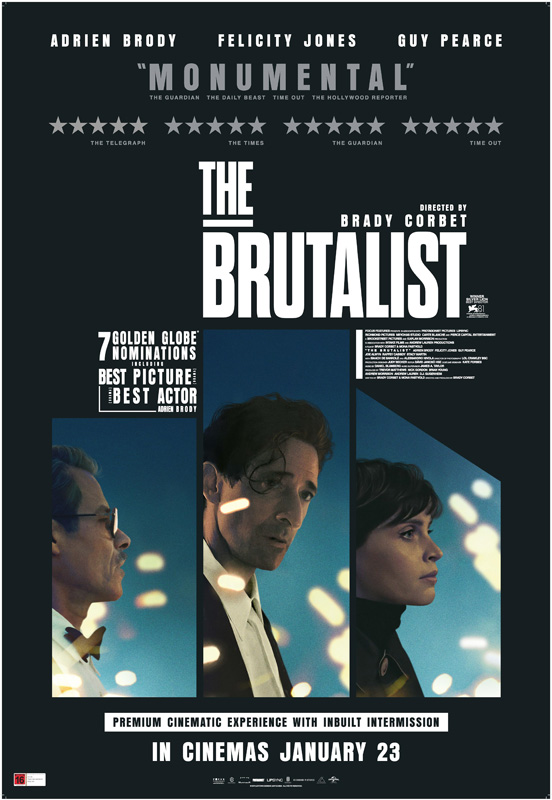
The arrival of The Brutalist marks a crucial maturation point in his career arc. The film operates as a grand crystallization of his early promise, solidifying his place in cinema history as a purveyor of the epic form. By tackling the immigrant experience and the American dream on a colossal scale, Corbet transitions from a provocative formalist into a definitive auteur capable of marshaling immense narrative and technical resources.
Today, Corbet occupies a rare space in the cinematic landscape. He stands as a bridge between European art house sensibilities and the expansive scale of classic American cinema. His insistence on shooting on celluloid and demanding extensive runtimes places him in direct conversation with the cinematic titans of the twentieth century, proving that the grand, uncompromising cinematic epic still has a vital place in modern critical discourse.
Thematic Preoccupations
At the core of Corbet's filmography is a profound interrogation of power dynamics and the transactional nature of artistic ambition. He repeatedly examines the friction between creative genius and the wealthy patronage required to sustain it. In The Brutalist, this obsession takes center stage through the relationship between a visionary architect and a wealthy industrialist. Corbet asks whether art can survive the demands of capital or if the artist is inevitably compromised by the hands that feed them.
The immigrant experience serves as another crucial pillar in his thematic architecture. Corbet strips away the romantic mythology of the American dream to reveal a brutal paradox. He highlights the grueling reality faced by those who arrive with nothing but their talent, forcing the audience to confront the systemic obstacles designed to break them. This exploration of displacement and resilience frames the immigrant journey not as a simple narrative of triumph, but as a grueling battle for identity and survival.
Monumental ambition itself is treated as both a virtue and a curse within his narratives. Corbet is fascinated by protagonists who possess an obsessive, uncompromising drive to build and create on a massive scale. This thematic concern perfectly mirrors his own directorial approach. The architectural dreams of his characters reflect his own cinematic aspirations, blurring the line between the subject matter and the creator.
Finally, Corbet consistently delves into the psychological toll of such monumental ambition. His work suggests that true artistic creation requires an exhausting expenditure of the soul. The resilience required to navigate hostile environments and unequal power structures is portrayed as a heavy burden. Corbet leaves viewers with complex philosophical questions regarding the true cost of artistic integrity and whether the resulting legacy justifies the human sacrifice required to achieve it.
Stylistic Signatures
The stylistic foundation of Corbet's work is built upon a bold formalism that demands complete audience surrender. He constructs his films with an architectural precision, utilizing sprawling and expansive framing to capture the sheer scale of his narratives. This visual language is inherently tied to his thematic concerns, as the monumental ambition of his characters is reflected in his uncompromising cinematographic choices. Every composition is designed to emphasize the weight of history and the imposing structures of power.
Pacing and rhythm form another essential component of his directorial signature. Critics frequently describe his temporal structures as exhausting yet rewarding, a deliberate choice that forces the viewer to endure the same arduous journeys as his protagonists. Corbet rejects rapid cutting in favor of measured, deliberate rhythms that allow the psychological tension to build organically. This demanding approach to time creates a deeply immersive experience, making the ultimate emotional payoffs feel earned rather than manipulated.
In terms of mise en scène, Corbet displays an obsession with tactile reality and historical authenticity. His aesthetic often draws favorable comparisons to Terrence Malick and films like There Will Be Blood, particularly in his ability to capture the raw, physical essence of postwar America. The environments in his films are never mere backdrops, they are active participants in the narrative. They oppress, inspire, and challenge the characters, perfectly externalizing the internal battles over artistic integrity.
His use of sound and music further amplifies this bold formalism. Corbet treats auditory elements as architectural materials, building dense and oppressive soundscapes that heighten the thematic focus on power and ambition. The integration of score and sound design is always aggressive and prominent, ensuring that the audience feels the massive stakes of the narrative. This holistic approach to style and sound confirms his status as a filmmaker of rare, uncompromising vision.
Recurring Collaborators
While a sprawling database of frequent cast members does not define Corbet's methodology across multiple projects, his approach to casting reveals a distinct collaborative signature. He actively seeks out performers capable of anchoring his monumental visions with deeply internal, commanding performances. Corbet requires actors who can project immense resilience while simultaneously conveying the fragile psychology of artistic obsession. The success of his demanding formalism relies entirely on the emotional gravity provided by these central figures.
His collaboration with Adrien Brody in The Brutalist stands as a defining example of this dynamic. Brody provides a portrait of genius and resilience that serves as the indispensable human core of the sprawling epic. Corbet clearly builds a protective yet challenging environment for his actors, pushing them to access profound depths of exhaustion and triumph. This specific partnership demonstrates how a singular, towering performance can elevate an already ambitious cinematic canvas.
Beyond the actors, Corbet's monumental scale necessitates intense creative partnerships with his production designers and cinematographers. To achieve the sprawling, architectural look that defines his work, he must align himself with technicians who share his uncompromising commitment to bold formalism. These invisible collaborations are the bedrock of his aesthetic, allowing him to visualize the imposing structures and historical textures that dominate his frames.
Ultimately, Corbet treats his key creative partnerships as vital alliances in his battle for artistic integrity. Just as the protagonist in The Brutalist must navigate the treacherous waters of patronage, Corbet relies on a trusted circle of collaborators to protect his vision from commercial compromise. This unified front behind the camera is precisely what allows him to execute such demanding, epic filmmaking without diluting his rigorous standards.
Critical Standing
The critical reception of Brady Corbet has evolved significantly, shifting from wary curiosity to deep, widespread respect. Early in his directorial career, his uncompromising style and demanding runtimes made him a polarizing figure among mainstream reviewers. However, serious critics and cinephiles quickly recognized his bold formalism as the mark of a true auteur. He has carved out a space as a filmmaker who categorically refuses to pander, earning a reputation for intellectual rigor and structural audacity.
His placement within the critical discourse is heavily defined by the comparisons he invites. By drawing parallels to the expansive epics of Terrence Malick and the fierce psychological portraits of Paul Thomas Anderson in There Will Be Blood, critics acknowledge Corbet as a successor to a grand cinematic tradition. The thematic parallels to The Fountainhead further underscore his intellectual ambition. He is frequently celebrated for possessing a vision that is nothing short of monumental. These comparisons validate his ambitious approach and secure his standing among the most important directors of his generation.
The critical consensus surrounding his pacing and narrative structure is uniquely paradoxical. Reviewers consistently describe his films, particularly The Brutalist, as exhausting yet rewarding. This phrase has become a badge of honor within critical circles, signifying that his work demands active engagement and emotional endurance. Critics respect him precisely because he challenges his audience, knowing that the dense thematic exploration of power and the immigrant experience requires a canvas of epic proportions.
Today, Corbet stands at the pinnacle of critical esteem for his uncompromising dedication to the art form. He is viewed not merely as a storyteller, but as a visionary architect of modern cinema. The Brutalist has definitively proven that his sprawling, ambitious methods yield profound results. As his standing continues to rise, he remains a central figure in discussions about the survival of the true cinematic epic in an increasingly commercialized industry.