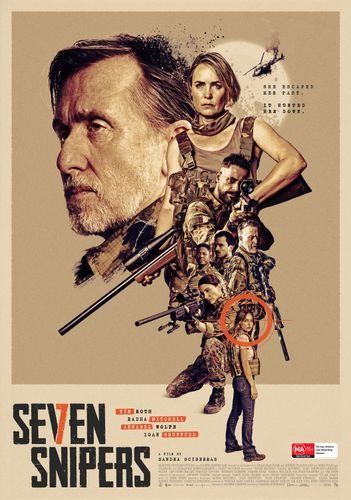
Career Overview
Sandra Sciberras occupies a distinct, if heavily debated, position within the contemporary landscape of Australian genre cinema. Emerging as a director willing to tackle monumental cinematic legacies, she centers her focus on the intersection of classical western tropes and modern action thriller mechanics. Her ambition to reinterpret canonical texts places her in direct conversation with the midcentury action traditions established by Akira Kurosawa and John Sturges.
Her career trajectory reveals a pronounced fascination with the ensemble cast thriller, culminating in her high-profile recontextualization of familiar survival narratives. By mounting projects like Seven Snipers, Sciberras signals a bold departure from traditional Australian outback cinema, pivoting instead toward globalized action frameworks. This shift demonstrates a calculated desire to infuse the sprawling, mythic dimensions of the classic western into a contemporary, female-centric context.
While her filmography may not yet boast the expansive volume of her structural influences, her current body of work establishes her as a filmmaker deeply invested in the mechanics of the remake. Sciberras operates at the nexus of homage and revisionism, attempting to carve out space for female empowerment within historically patriarchal genre structures. Consequently, her artistic identity is inextricably linked to her dialogue with cinematic history and her polarizing efforts to update the iconic classic for a modern audience.
Thematic Preoccupations
The cinema of Sandra Sciberras is fundamentally anchored in the thematic exploration of survival and martial duty. She consistently interrogates the philosophical weight of violence when wielded by those pushed to the absolute margins of society. In Seven Snipers, this preoccupation manifests through the lens of maternal protection and the assembly of a highly specialized ensemble cast. Her protagonists do not engage in combat out of inherent bloodlust, but rather out of an inescapable, often reluctant obligation to defend familial bonds against predatory forces.
A central obsession within her work is the recalibration of female empowerment within the rigidly defined boundaries of the action thriller. Sciberras dismantles the traditional masculine archetype of the lone gunslinger, replacing it with a collective of formidable women who operate with lethal precision. This gendered revisionism attempts to subvert the established norms of the western genre, questioning how trauma, motherhood, and lethal expertise can coexist within a single narrative framework.
Furthermore, Sciberras remains deeply invested in the archetypal structure of the defensive siege. By drawing directly from the thematic reservoirs of classic action cinema, she continuously asks how isolated individuals can forge temporary, tactical alliances to combat systemic or localized tyranny. Her narratives frequently examine the cost of such alliances, probing the moral compromises required to sustain a relentless battle for survival in an unforgiving, sun-scorched environment.
Ultimately, her work wrestles with the inescapable shadow of cinematic history. The thematic echoes of midcentury cinematic landmarks serve as a foundational text that Sciberras actively attempts to rewrite. She probes whether the heroic sacrifices celebrated in the mid-twentieth century can still resonate in a contemporary setting, using the isolated Australian ranch as a modern frontier where age-old questions of justice and retribution are settled through ballistics.
Stylistic Signatures
The stylistic framework of Sandra Sciberras relies heavily on the visual lexicon of the classical western, transposed onto the arid expanses of the Australian outback. Her mise-en-scène is characterized by a stark, utilitarian aesthetic that emphasizes the isolation of her characters. By utilizing wide, sweeping landscape shots, she explicitly references the frontier environments of her cinematic predecessors visually, framing her elite kill squads against vast, unforgiving horizons that diminish the human figure while amplifying the existential stakes of their mission.
In terms of editing rhythm and kinetic pacing, Sciberras adopts a highly polarizing approach that eschews the frenetic montage of contemporary action thrillers. Her pacing is frequently described as deliberate or slow-paced, demonstrating a structural allegiance to the methodical narrative build found in midcentury cinema. Rather than surrendering to the chaotic abandon of frequent action, she carefully maps out the spatial geography of her set pieces. This restraint results in a cinematic rhythm that often refuses to shift out of first gear, favoring atmospheric tension over breathless velocity.
Her choreographic style within action sequences prioritizes tactical realism and spatial coherence over stylized violence. When the relentless action does erupt, it is depicted with a grounded, unglamorous brutality. The sound design complements this approach by highlighting the mechanical, heavy reality of the weaponry used by her ensemble cast. The sharp, percussive crack of sniper fire is often isolated against the ambient silence of the Australian ranch, creating a stark auditory contrast that underscores the lethal precision of her formidable female protagonists.
Finally, Sciberras utilizes framing to construct an iconography of female resilience. She frequently employs low-angle shots to monumentalize her ensemble cast, consciously mirroring the heroic framing traditionally reserved for male actors in classical action cinema. This visual strategy, combined with a muted color grading that emphasizes the dry, sun-bleached reality of the setting, cements her distinct visual signature as one that attempts to merge arthouse deliberation with the visceral requirements of the survival thriller.
Recurring Collaborators
While Sandra Sciberras has not yet cultivated a recognizable repertory company of recurring onscreen performers, her approach to assembling a cast is central to her directorial methodology. She relies heavily on the concept of the ensemble cast, favoring a diverse collection of actors who can convey both individual expertise and cohesive tactical unity. This absence of a fixed, returning ensemble forces each film to establish a unique group dynamic, requiring her performers to quickly build believable camaraderie and shared traumatic histories within the confines of a single narrative.
Her most notable and critically scrutinized creative partnership occurs behind the camera, specifically in her screenwriting collaborations. By enlisting high-profile literary and television talents, such as novelist and creator Nic Pizzolatto, Sciberras seeks to infuse her genre exercises with a specific brand of hardboiled, philosophical dialogue. This collaboration aims to merge her visual ambitions with a gritty, character-driven textual foundation, attempting to ground the high-stakes action thriller in complex psychological realism.
However, the synthesis of her directorial vision and the contributions of her co-writers often yields a complicated creative friction. Collaborators known for their intense, male-centric crime narratives provide an intriguing, if occasionally discordant, counterpoint to her focus on female empowerment. This partnership underscores her willingness to bridge differing creative sensibilities, utilizing established writers to help navigate the tricky adaptation and modernization of deeply entrenched cinematic tropes.
Moving forward, the evolution of Sciberras as a prominent auteur will likely depend on whether she establishes a dedicated crew of cinematographers and editors to unify her deliberate pacing and expansive visual style. For now, her primary collaborative signature remains her willingness to engage with disparate voices in the scripting phase, using the ensemble format not just for her onscreen characters, but as a guiding principle for her behind-the-scenes creative process.
Critical Standing
The critical reputation of Sandra Sciberras remains highly contested, characterized by a sharp divide between mainstream genre appreciation and rigorous formalist critique. Her overt reliance on the architectural foundations of Akira Kurosawa and John Sturges invites inescapable, often punishing comparisons. For many art critics and cinephiles, her work is viewed through the lens of the unoriginal thriller. Detractors frequently label her output as a disposable remake, arguing that she adds nothing of particular value to the iconic classic source materials she so closely mimics.
A significant portion of critical discourse surrounding her filmography focuses on her command of tone and pacing. Reviewers often point to a frustrating lethargy within her narrative momentum, noting a deliberate, slow-paced execution that prevents her films from achieving the cathartic release expected of a thrilling action picture. Publications such as Slant Magazine have explicitly criticized her directorial restraint, arguing that her refusal to surrender to the inherent kinetic energy of the genre leaves her work stranded in a perpetual state of first gear, unable to fully capitalize on its potential.
Conversely, a contingent of industry defenders champions her work for its conceptual audacity and its commitment to female empowerment. Trade publications and mainstream outlets frequently highlight her creation of a formidable remake, praising her ability to translate the rugged, masculine ethos of the classic western into a modernized, female-led battle for survival. These defenders argue that the relentless action and tactical precision she puts onscreen represent a necessary, violent corrective to the historical exclusion of women from the classic action ensemble.
Ultimately, Sciberras occupies a polarizing, liminal space within contemporary cinema. She is simultaneously dismissed by purists as an architect of derivative pastiche and commended by genre enthusiasts for attempting to violently dismantle patriarchal archetypes. As her career progresses, her standing will depend entirely on her ability to transcend the long shadow of her influences, transitioning from a competent mimic of midcentury masters into an undisputed, original voice in the global action landscape.